


Organic Wine
by Vicky Hayward

Pictures: Rafael Vargas, courtesy of the Spanish Institute for Foreign Trade (ICEX)
In the three years since I wrote this article organic winemaking has taken off in a big way. The number of bodegas making organic wines has doubled and there are a total of 16,037 hectares (39,627 acres) of registered organic vineyards, with the largest cluster in Murcia region. Contacts for the regional bodies who supervise organic farming and keep a complete register of producers are given on the Ministry of Agriculture, Fishing and Food website: www.mapya.es
In 1979 Spain’s first certified organic vines were planted in a small patch of vineyard close to Catalonia’s cava capital, Sant Sadurní d’Anoia. At the time Josep María Albet i Noya ran the vineyard alone with part-time seasonal help, selling the wine in bulk for bottling in other Penedés bodegas. Today, the bodega has three oenologists and makes two dozen wines from sixteen varieties of organically grown grapes. Every year the wines, which range from a lightly oaked varietal white made from the native Xarel-lo grape to a Cabernet Sauvignon Crianza and, of course, a cava, win a clutch of regional, national and international prizes. “There is no reason why wines made from organic grapes cannot compete in quality with the very best of the other wines on the market,” comments Josep María. In the twenty years it has taken for Albet i Noya to find its place as a premier bodega, organic winemaking has spread to sixteen other wine regions and over eighty wineries of all kinds — small family operations, cooperatives, and renowned bodegas. Each wine has a clear personality closely tied to its terroir. But all the winemakers share the belief that good organic growing is more than an environmental issue; it also gives the potential for superb wine.
On a bitter January day green spikes of rye, vetch and rye grass are breaking through the cold earth between the rows of vines planted below Albet i Noya’s farmhouse-bodega. The vines here are trained high on wire trellises to give maximum exposure to the sun and air. Later in the winter the manuring crops will be ploughed up so the vines can make the most of the light spring rains and, after mulching down with vine prunings, they will be dug into the soil with home-made compost.
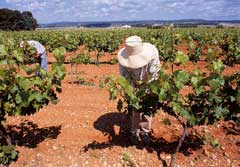
Much of the vineyard work here is done laboriously by hand: spring pruning, pinching out the vines’ leaves as the fruit ripens and harvesting, too, to prevent insects, animals and dirty fruit slipping into the crushing hopper from which the grape musts are piped off to small stainless steel deposits for fermentation by variety and vineyard. The red wines and some of the whites are at least partially fermented on the grapeskins. After racking, blending and wood-ageing, which varies for each wine and vintage, they are gently filtered through cellulose and bottled with an inert gas below the cork. “It is essential to keep sulphur levels low,” comments Josep y María.
Research is an integral part of Albet i Noya’s winemaking. A small area of the vineyard below the bodega is set aside for trials with pruning, trellising and vine-training techniques. Elsewhere fourteen grape varieties — some of them neglected native grapes, others imported — are being grown as part of a five year project, monitored by the Catalan Institute of Vines and Wine (INCAVI), to test their winemaking potential. Each grape is being vinified two ways and aged on five woods ranging from cherry to chestnut.
In parallel, the winemaking evolves. New varieties have been planted. “In Australia I fell in love with Syrah so I thought, why not try it?” says José María. “My view is that you only live once, you only have one chance to try things out. It keeps winemaking interesting.” The bodega also now buys in grapes from fifteen organic growers, some of whose vineyards were planted over 70 years ago. In this way production has not only grown; it has also diversified around the Penedés microclimates to make single-vintage Macabeo, Xarel.lo, Tempranillo, Cabernet Sauvignon and Chardonnay varietals as well as blended wines.
Today the restless search for quality is paying off. In 1999 the bodega’s sales, 80% of them abroad, reached 340 million Ptas, part of which is paying for buiding work to double the bodega’s capacity. But Josep i María emphasizes that organic growing is not in itself a commercial end.
For me organic growing is inseparable from making wonderful wines. That, rather than organic growing, is the hard bit.
A Late Start
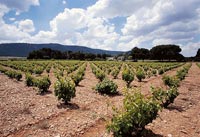
Spain’s southern climate and altitude naturally lend themselves to organic growing. But with the exception of a few notable pioneers — such as Peréz Caramés in El Bierzo, Ca’n Majoral in Mallorca, Gómez Nevado in Cordoba and Dominio de los Pinós in Valencia — most organic bodegas here did not begin producing until the late 1990s.
“Ten years ago Spain was exceptional among the world’s major wine producers in its lack of organic production,” comments Jem Gardner of specialist English wine-merchants Vinceremos. “But in the last few years there has been a real explosion of interest in different regions.”
One can speculate on the reasons for the late start: the association of organic growing with rough country wines; the conspicuous absence of a major national wine scandal; lack of research or information on organic growing; and, as a result, the fear of handling bug invasions without falling back on systemic chemicals.
Another fear was economic viability. In this sense the example of pioneers like Albet i Noya has been decisive. They have showed that organic growing is both cheaper and less risky in Spain than in northern Europe thanks to the natural advantages of climate and, often, altitude.
“I’d say that in Spain organic costs 10-20% more than conventional growing,” comments Josep María. Estimates by makers in the Rioja and Levante go up to 25% — but never as high as 40%, as in some areas of central Europe. But, as Josep María adds, “What is expensive is producing quality, which can cost up to 500% more.”
Nevertheless, at this level of the market too, organic wines have showed they can pay for themselves thanks to their value in international markets.
“It is a very different world to the rest of the wine business,” explains Madeleine Olaechea of Dominio Los Pinos, which began organic winemaking in 1989. “Buyers are not so interested in the region, the label — they want to visit the vineyard, taste the wine and keep in personal contact. But providing they like the wine, they keep coming back for more.”
From Natural to Organic
In fact, alongside that, Spain has a tradition of wines that are virtually free of chemical residues. In areas with a dry continental climate’s freezing winters and blazing summers — for example, Priorato, the Ribera del Duero or Toro — mildew, botrytis and pests like grape caterpillars remain at such low levels that growers have never used more than a minimum number of preventive treatments. The average sulphite levels of Ribera wines today — around 45mg total per litre — fall well within organic maximum levels.

More generally, too, systemic chemical fertilizers and pesticides arrived late in Spain. “Until the 1950s everything here — wheat, barley and vines — was grown the old way, with sulphur or copper if and when you needed it,” explains Felipe Martínez, aged 70, from Muzarabal, in northern Navarra. “Weedkiller began to arrive in the 1950s, but it was another thirty years before the farmers began to buy chemical fertilisers. And then, very quickly, everyone saw that although it helped produce more grapes, their quality was not the same as before.”
While some of Spain’s traditional wines were produced by small-scale growers for local consumption, others were made by renowned bodegas. Estate-bottled vinos de pago (domaine wines) such as Remelluri and Marqués de Vargas in the Rioja, Terras Gauda and Fillaboa in southern Galicia, Pago de Carraovejas or Marqués de Velilla in the Ribera del Duero, come from vineyards that have long been close to organic. Such growing methods give precisely what fine winemakers seek: smaller harvests of high quality grapes expressing the full character of the vine’s variety without the muddied aromas or taste of residual chemicals.
This tradition of natural winemaking was never much commented on, least of all by the makers themselves. Many preferred to let the quality speak for itself or simply took traditional methods for granted. “It was part of our family’s way of life,” says Andreu Oliver, who makes Ca’n Majoral, a Mallorcan wine. “We always grew organically, but certifying wasn’t possible here until 1985 and it didn’t seem anything special.”
Even today, many wines made from organically grown grapes don’t declare their origins. Manuel Valenzuela, who produces Barranco Oscuro, a respected wine from an organic vineyard in the Alpujarras, once commented to Vinum magazine, “I do not use chemical fertilizers because my vineyard will turn into a desert. But I don’t want to go further than that and make a statement — it could produce sectarianism.”
Likewise, Ca’n Majoral doesn’t label all its wine as organic. “Our idea isn’t so much to make and sell an organic wine as to think and work in an organic way and produce a really good wine. There’s a difference.”
But the strength of this tradition meant that once interest was awakened, certified organic growing could implant iself very quickly. The knowledge was there, often for the asking from older farmers who still followed old ways, and there were virtually organic vineyards in many growing areas such as Montilla, Priorato and Navarra, where organic winemaking has quickly settled into DO regions.